
Essay
I wrote recently that status pages are not just operational utilities. They are trust surfaces. That argument is easy to make in theory. It matters more in practice.
So I built a status page around that idea.
Not a default provider page. Not a raw monitor feed with a logo on top. A designed surface that takes system signals, interprets them deliberately, and presents them differently depending on audience and purpose.
That distinction matters.
Most status pages still inherit the shape of the monitoring tool behind them. The provider defines the model, the terminology, the layout, and often the assumptions about what users should see. The result is usually functional. It reports uptime, incidents, and checks. But it still leaves too much interpretive work to the reader.
That is the gap I wanted to close.
The design move
The key change was simple: separate monitoring from status.
Monitoring systems generate signals. Status surfaces should interpret and present them.
That means treating raw checks, freshness, warnings, maintenance windows, and service roll-up as inputs into a designed communication layer, not as the communication layer itself.
In practical terms, the page works as a small interpretation system.
Architecture: signals are collected upstream, normalised into a consistent internal shape, then used to derive service state before presentation is split between public reassurance and operational investigation.
Signals are collected upstream. They are normalised into a consistent internal shape. Service state is then derived intentionally. Only after that does presentation happen.
That matters because status is never just data. It is meaning under uncertainty.
Two audiences, two surfaces
The implementation has two views: public and operations.
They are connected, but they are not the same.
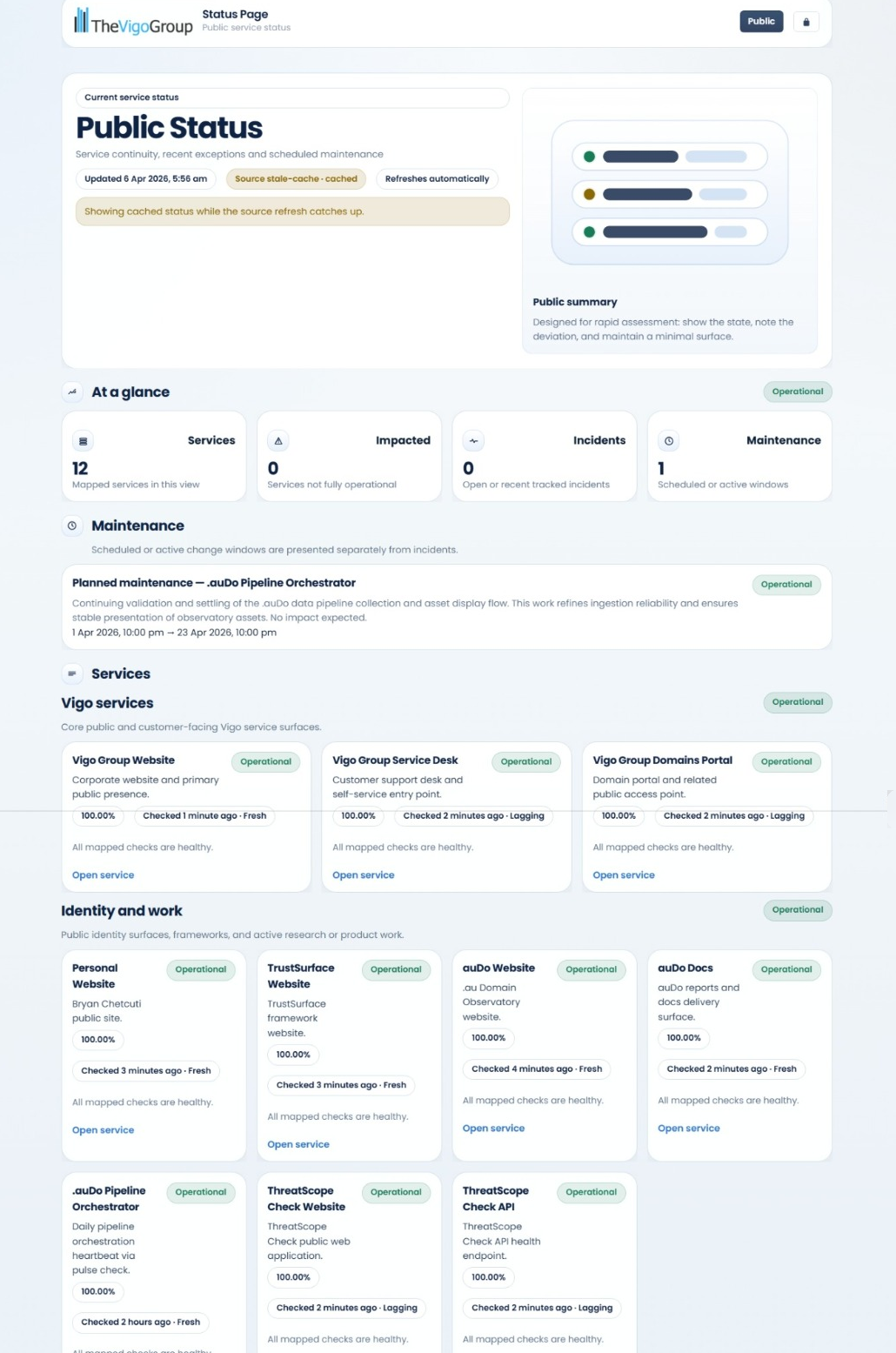
The public view is designed to answer the simplest and most important question:
Is it working, and should I trust what I am seeing?
That means a smaller cognitive footprint. Fewer internal details. Clear service state. Maintenance separated from incidents. Enough explanation to preserve confidence, but not so much that the reader has to decode internal mechanics.
It is intentionally calm.
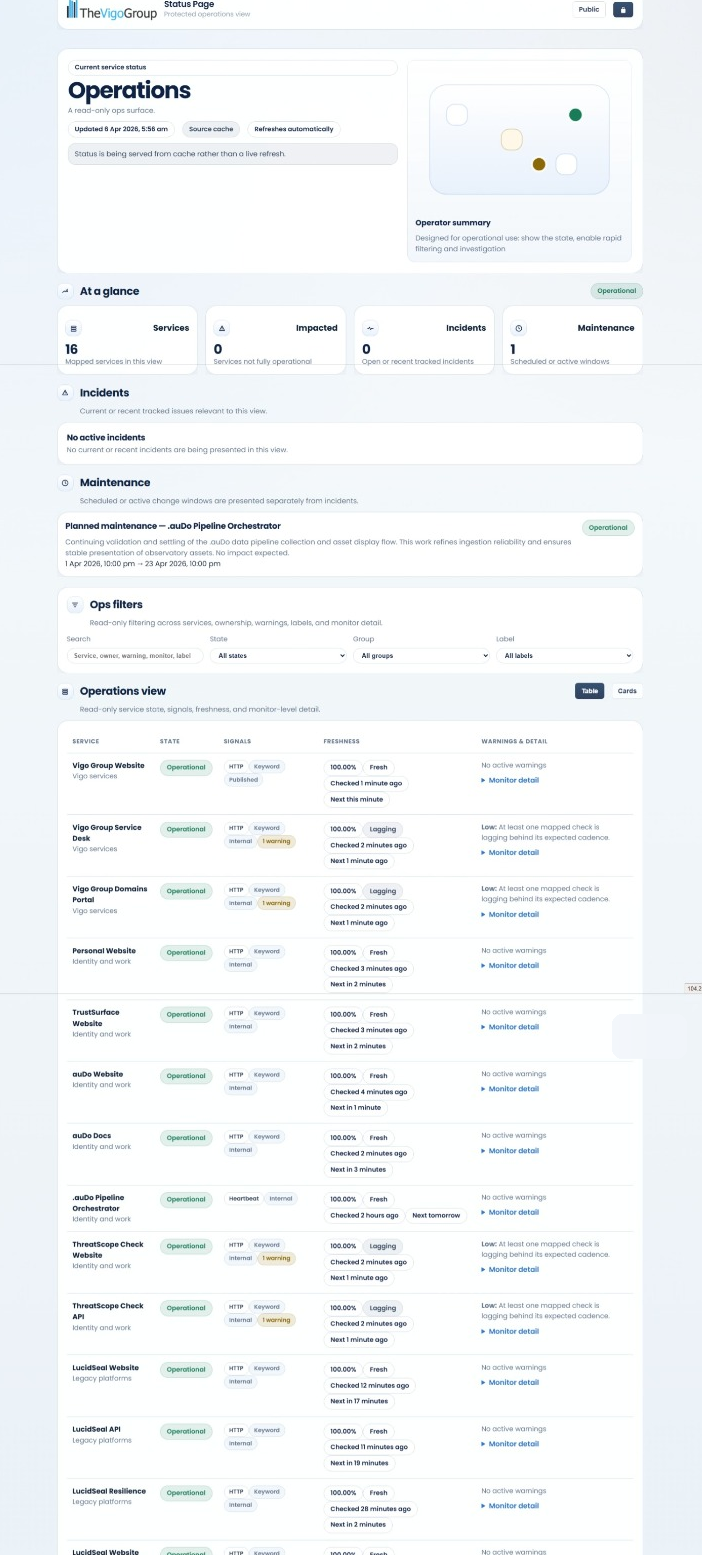
The operations view answers a different question:
Why is it in this state, and what should I look at next?
That surface carries more of the system’s internal logic. Filters. Signals. Freshness. Warnings. Monitor detail. Grouping. Raw provider access where needed. It is still structured and restrained, but it is designed for investigation rather than reassurance.
That split is the point.
A public user should not need to think like an operator to understand service condition. An operator should not need to fight a public-facing summary to find the signal that matters.
What changed from the default model
A provider-shaped page tends to expose the monitoring worldview directly.
That often means every check looks equally important until you already know otherwise. It means the reader is asked to infer meaning from fragments: one degraded check here, another fresh result there, maybe a maintenance banner, maybe a list of green dots. Technically transparent, but operationally thin.
Owning the status surface means making some decisions before the incident does it for you.
- Which signals are primary?
- Which are supporting?
- What does “operational” mean in this environment?
- When should lagging data be visible without causing unnecessary alarm?
- When should maintenance be surfaced separately from incidents?
- What belongs in the public surface, and what belongs only in the operator view?
Those are not provider decisions. They are operator decisions.
And once they are treated that way, the page starts to behave less like a generic utility and more like a product surface.
Why this matters
Status is one of the few places where system reality is exposed almost directly to interpretation.
People do not only read status pages for facts. They read them for posture.
They are looking for signs of control. Signs that the organisation understands its own systems. Signs that what is being said matches what is happening. Signs that maintenance, degradation, and continuity are being handled deliberately rather than reactively.
That judgement happens quickly.
A noisy, tool-shaped page tends to communicate exposure. A calm, designed page communicates ownership.
That does not mean hiding detail. It means putting detail in the right place, in the right form, for the right audience.
The operations view still carries the depth needed for inspection. The public view still stays honest about current state. But neither audience is forced to read the other audience’s surface.
That separation improves clarity for both.
What I was actually trying to prove
This was not just a design exercise.
I wanted to test whether the idea in the essay could hold up as a working pattern:
- signals collected separately from presentation
- state derived deliberately
- public and operational surfaces split by intent
- provider output retained as an input, not treated as the final product
- status expressed as part of trust, not just uptime
The answer, at least so far, is yes.
The system feels more coherent because the communication model is coherent.
That is the deeper lesson here.
Owning the status surface is not about making a prettier status page. It is about deciding what status should mean before a provider, a dashboard, or an incident defines it for you.
For systems where trust matters, that is not cosmetic work.
It is part of the operating model.
Related: Owning the Status Surface · TrustSurface Framework